

Poppy seed roll is a classic yeast cake with soft dough and a sweet, aromatic poppy seed filling. The rich poppy mixture is packed with nuts, dried fruit, and candied orange peel, so every slice is full of flavor and texture. It’s a traditional treat for Christmas and Easter tables, but also perfect any time you want something special to serve with coffee or tea.
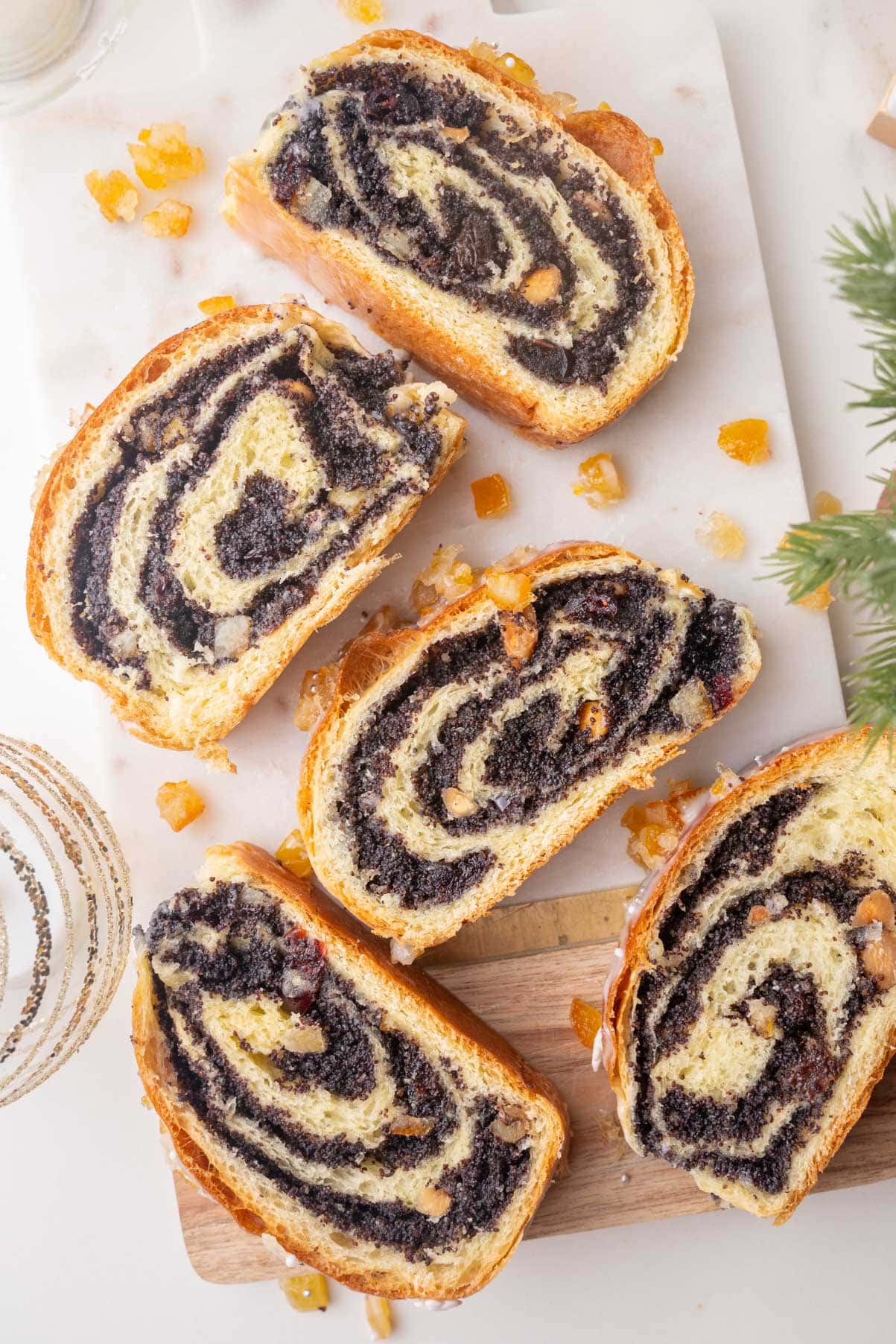
Poppy Seed Roll
Poppy seed roll is a sweet yeast roll filled with a thick poppy seed mixture and baked as a log, then sliced. It’s especially popular in Poland (where it’s called makowiec zawijany which means rolled poppy seed cake), Germany (Mohnstrudel/Mohnrolle), and other Central and Eastern European countries, where it’s often served for Christmas and Easter, but also enjoyed all year round with coffee or tea.
Ingredients
Here’s what you need to make the dough:
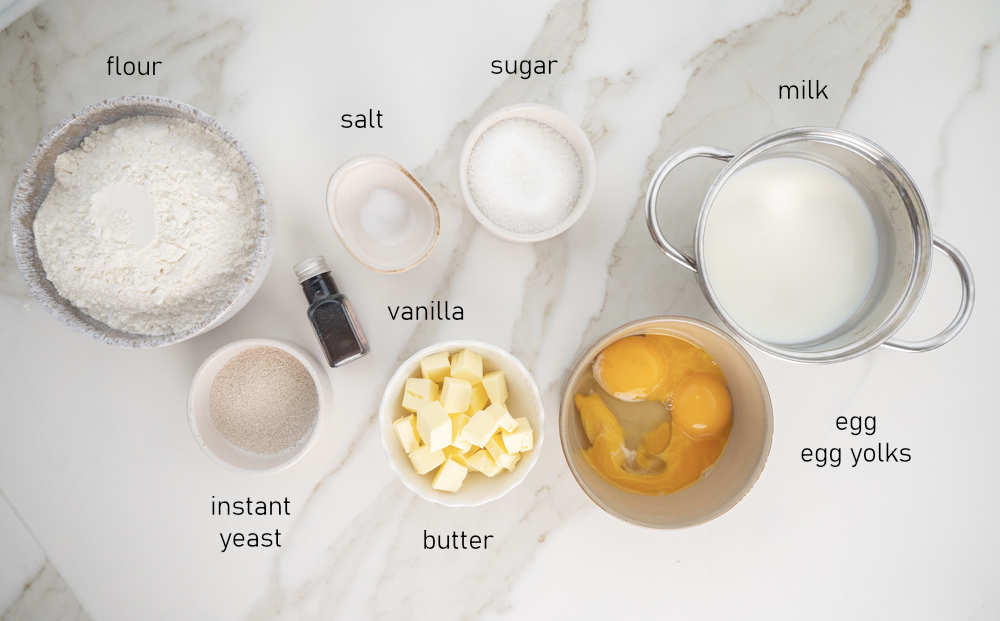
These are standard ingredients for a yeast dough with a touch more butter and some egg yolks for richness.
Here’s what you need to make poppy seed filling:
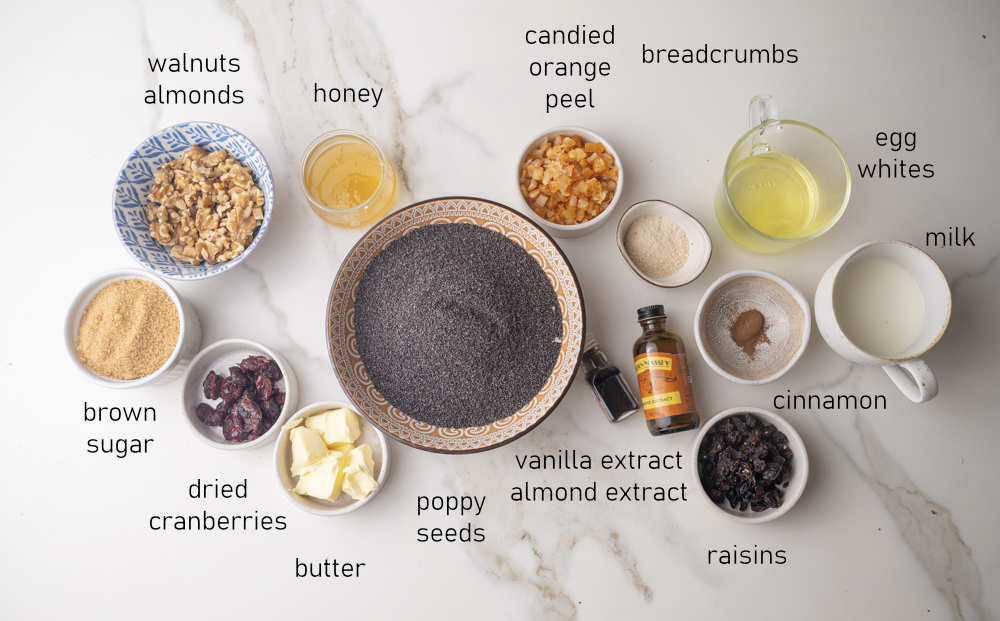
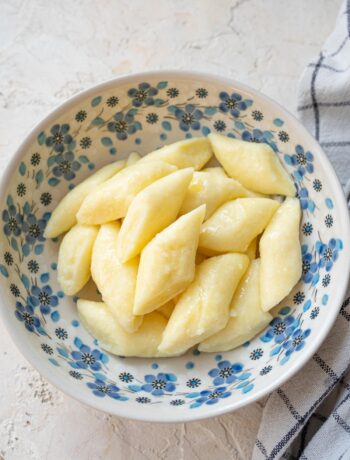
This is a universal recipe for a poppy seed filling that you can use to make kutia (Polish Christmas poppy seed and wheat berry dessert), poppy seed buns/bread/strudel/pastries, cookies (you can use it as a filling for these rogaliki cookies), or kluski z makiem – a traditional Christmas dish in some regions of Poland (the filling is loosened with some milk and used without the egg whites, then served with a short-type pasta).
If you would like to try a different filling for this cake, the nut and chocolate filling, from the nut roll (if a form of a wreath) would be perfect.
What you need is:
- Poppy seeds – you can use whole or ground. Try to find ground poppy seeds, they are ready to use, you don’t have to cook or grind them. A small amount of milk is added to ground poppy seeds to moisten them. If using whole poppy seeds, you need to cook them in a larger amount of milk.
- Nuts and dried fruit of your choice. I like to use raisins and cranberries. Sour cherries are also nice. I don’t recommend dried apricots – they are a little bit too hard. For the nuts, I like walnuts and almonds – pecans would also be nice but are not traditional.
- Candied orange peel – is a must for this dessert! Perfect for the filling and also very often used as a decoration.
- Optional flavorings – vanilla, almond extract, cinnamon.
- Sweeteners – brown sugar (has more flavor than white sugar) and honey.
- Butter – moistens the filling and makes it richer.
- Egg whites (whipped) – are necessary to “glue” the filling, otherwise it would be crumbly.
How to make it step-by-step
Make the dough
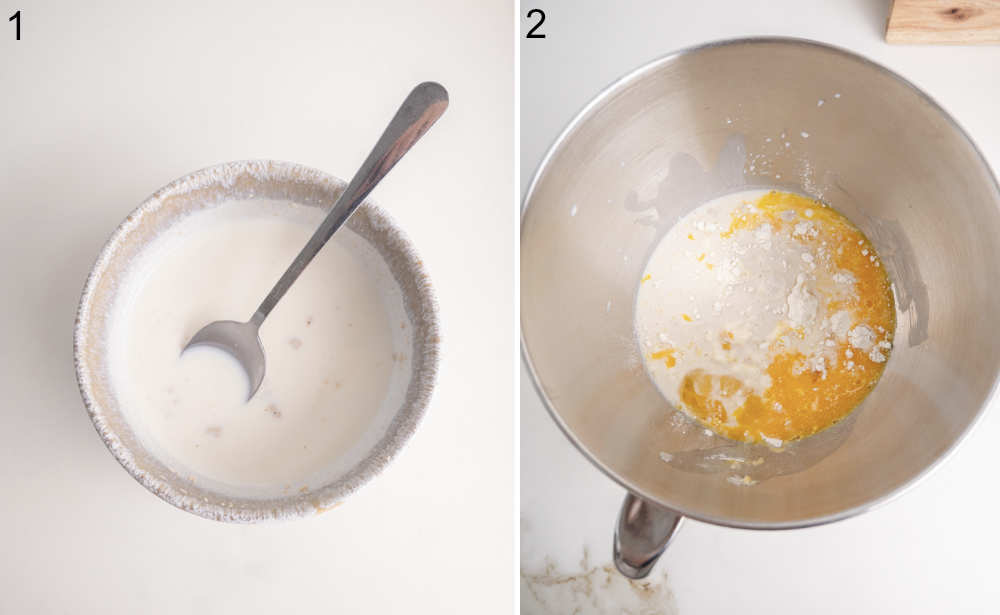
STEP 1: Cut the cold butter into small cubes and place it on a plate. This way, the butter should become soft by the time we need to incorporate it into the dough.
Warm up the milk until it reaches a temperature of 100–110°F (38–43°C) or feels pleasantly warm to the touch. Stir in the yeast.
(5 tablespoons (70g) soft butter, ½ cup (120ml) milk, 1 package (7g or 2 ¼ teaspoons) instant yeast)
STEP 2: To a large mixing bowl, add flour, salt, sugar, vanilla, lightly beaten egg, and egg yolks. Pour in the milk–yeast mixture.
(2 ½ cups (310g) flour, spooned and leveled, ¼ teaspoon salt, ¼ cup (50g) sugar, 2 teaspoons pure vanilla extract, 1 large egg, 2 large egg yolks, reserve the egg whites for the filling)
Measuring flour: I use the spoon-and-level method (1 cup = 125g). Fluff the flour, spoon it into your cup, then level it with a knife. A digital scale will give the best and most consistent results.
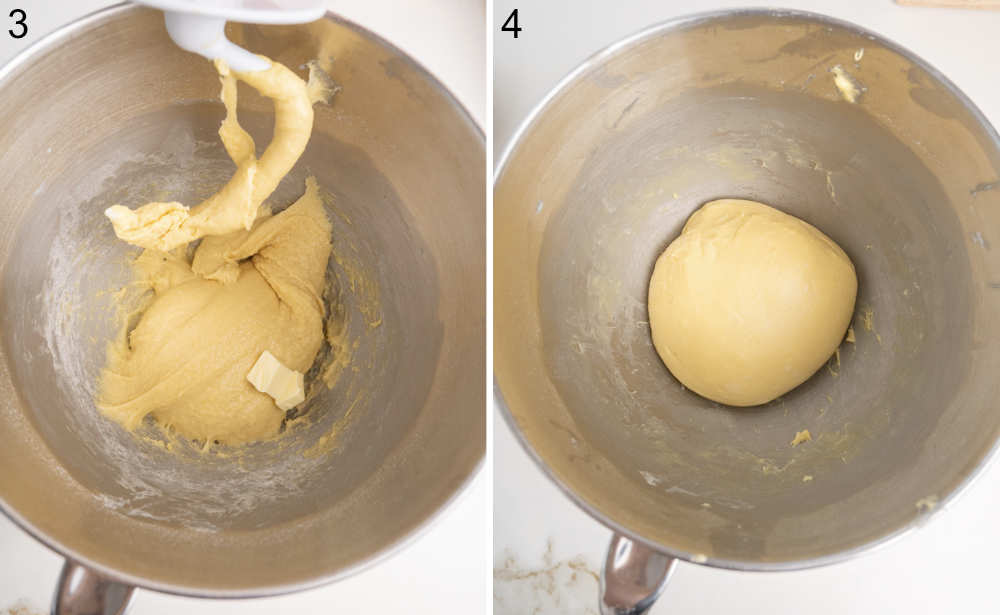
STEP 3: Knead the ingredients for a couple of minutes until well combined, then gradually add the soft butter, one small piece after the other, and mix until incorporated.
STEP 4: Knead the dough by hand for 10–15 minutes or with a hand mixer fitted with a dough hook for about 5–10 minutes, until a smooth dough forms. If using a mixer, when the dough is nearly ready, transfer it to the counter and finish kneading by hand.
First rise: Cover the bowl with plastic wrap and let rise in a warm place until doubled in size, about 1 hour. I usually place it in a turned-off oven with the light on.
Make the filling
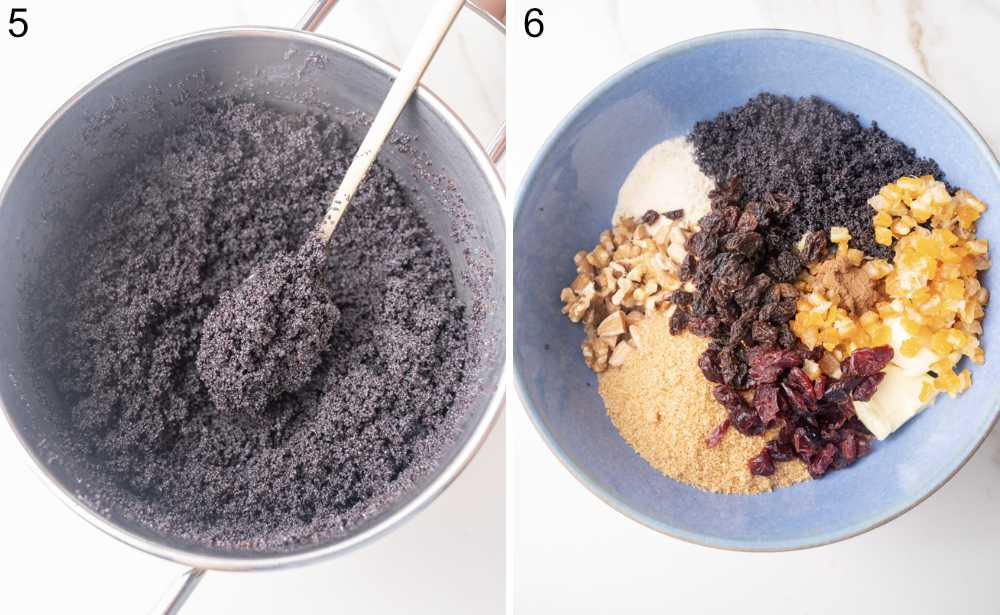
STEP 5: Add milk and honey to a medium saucepan and bring to a boil. Add ground poppy seeds and stir until combined, cook for a minute, then take off the heat. Make sure the poppy seeds are thick and there is no liquid visible.
(2 ¼ cups (200g) ground poppy seeds, 1/3 cup (80g) milk, 2 tablespoons honey)
If you only have whole poppy seeds: This recipe uses ground poppy seeds for convenience. If you only have whole poppy seeds, grind the same weight in a poppy seed grinder or a coffee/spice grinder, in small batches, until very fine and slightly moist/oily. Then use them exactly as written in the recipe (heat with milk and sugar).
You can also first simmer the whole poppy seeds in enough milk to cover them for about 10 minutes, drain well, then grind them while still warm in a poppy seed grinder. Use them straight away, without cooking them again in milk. Make sure the poppy seed mixture is thick and not watery.
STEP 6: Add the poppy seeds to a large bowl and add all the other ingredients for the filling except the egg whites. Stir until everything is well combined and there are no streaks of butter. Make an indentation in the middle of the filling and spread it up the sides of the bowl so that all of the filling chills uniformly. Place the bowl in the fridge while you are whipping the egg whites.
(1/3 cup (50g) chopped candied orange peel, ½ cup chopped nuts, I used walnuts and almonds, ¼ cup raisins, roughly chopped, ¼ cup dried cranberries, roughly chopped, ½ cup +2 tablespoons (125g) brown sugar, 1 tablespoon pure vanilla extract, ¼ teaspoon cinnamon, 1/8 teaspoon almond extract, 1 tablespoon fine breadcrumbs, 3 tablespoons soft butter)
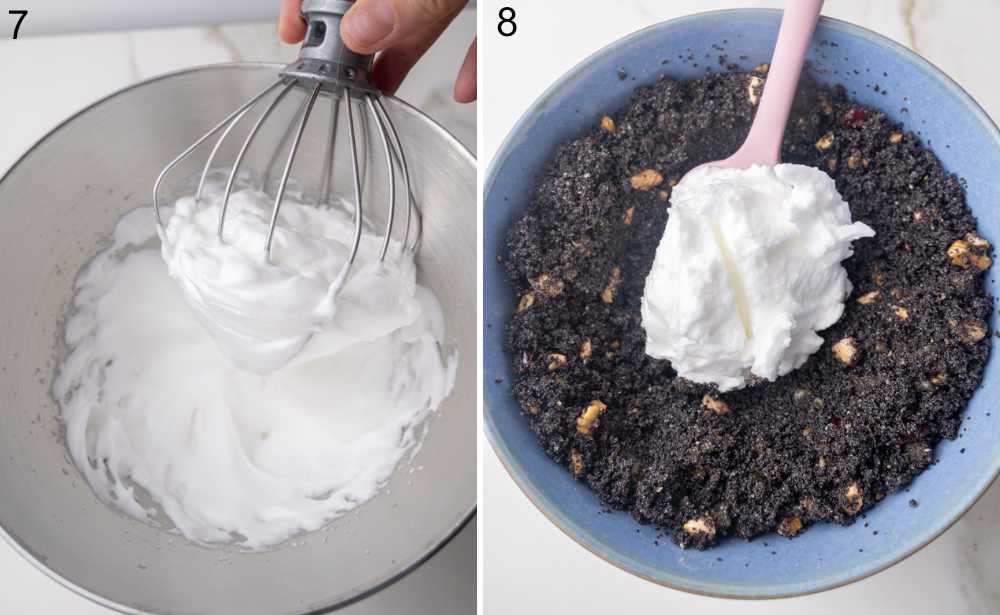
STEP 7: Whip the egg whites with a pinch of salt until stiff (if you turn the mixing bowl upside down, the egg white foam should not move), but be careful not to overbeat them.
STEP 8: Take the filling out of the fridge and carefully fold in the egg whites in three increments. Do not stir vigorously so you don’t lose the puffiness of the whipped egg whites too much.
Set aside.
Assemble
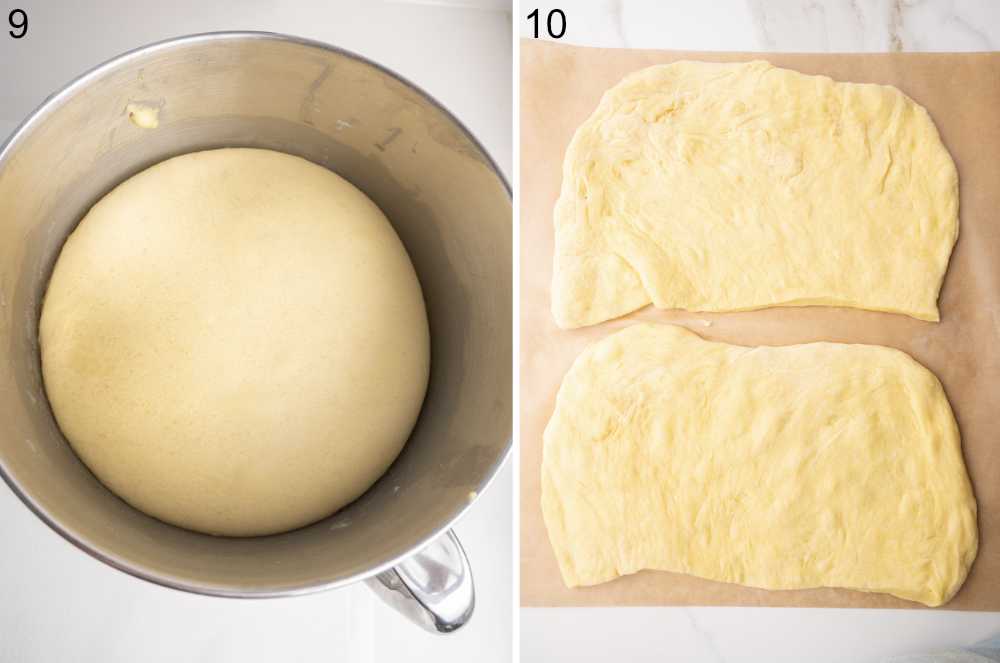
STEP 9: By the time you are done with the filling, the dough should have risen. Punch the dough down to release gases and place it on a piece of parchment paper.
STEP 10: Sprinkle 1 Tbsp of flour on all sides of the dough, stretch it into a small rectangle, and cut it in half. Cover with another piece of parchment paper and put in the fridge for 10 minutes (this will help to roll out the dough to an even thickness and also firm it up so it is easier to handle while rolling it up into a roulade).
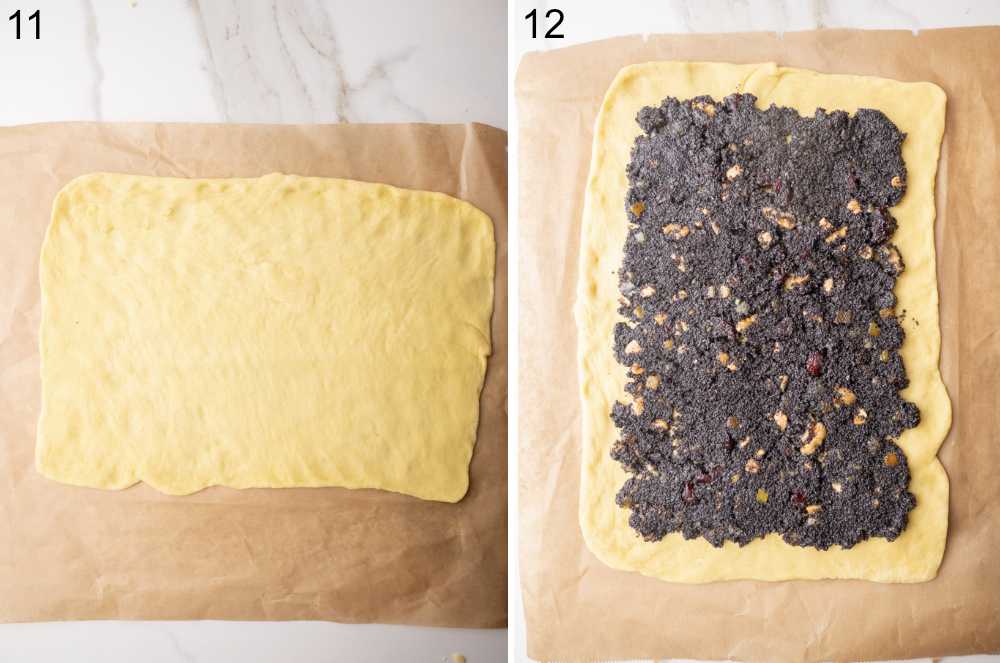
STEP 11: After 10 minutes, take one piece of dough from the fridge and roll it out into a rectangle, about 8×12 inches (20×30 cm).
STEP 12: Spread half of the filling in an even layer over the dough, leaving a ½–¾ inch (1.5–2 cm) border.
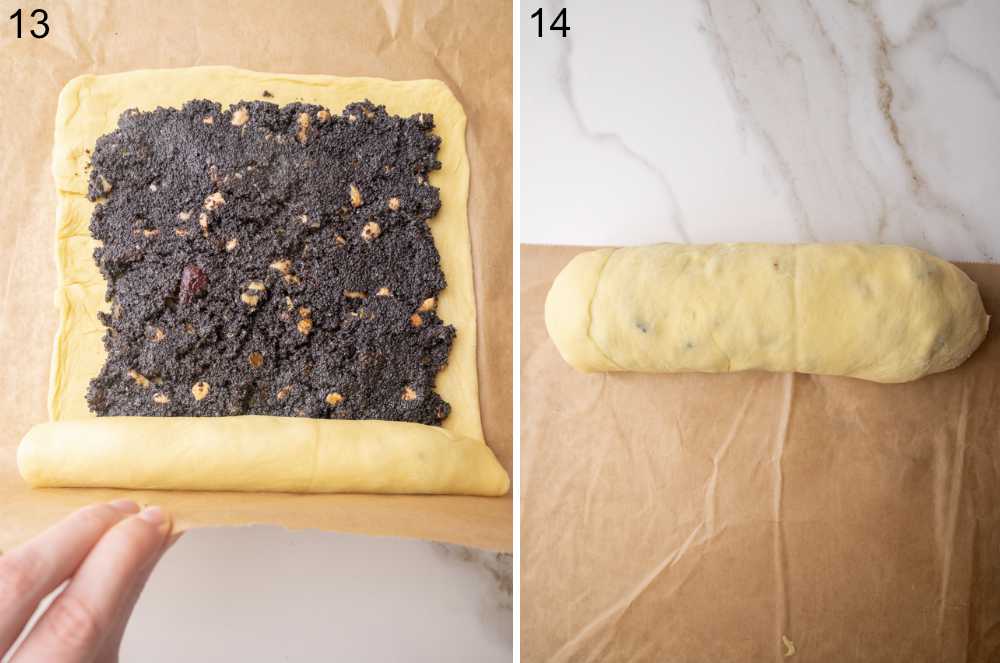
STEP 13: Roll up from the short side into a roll. Help yourself with the parchment paper which should be under the dough – lift the paper and the dough should roll onto itself. Don’t try to roll the dough too tightly – it will stretch and may get too thin (the dough is quite delicate, that’s why we chilled it a bit).
STEP 14: Tuck the edges under the dough and place (or slide the roll) on a baking sheet lined with buttered parchment paper, seam-side down.
Repeat with the second part of the dough and filling.
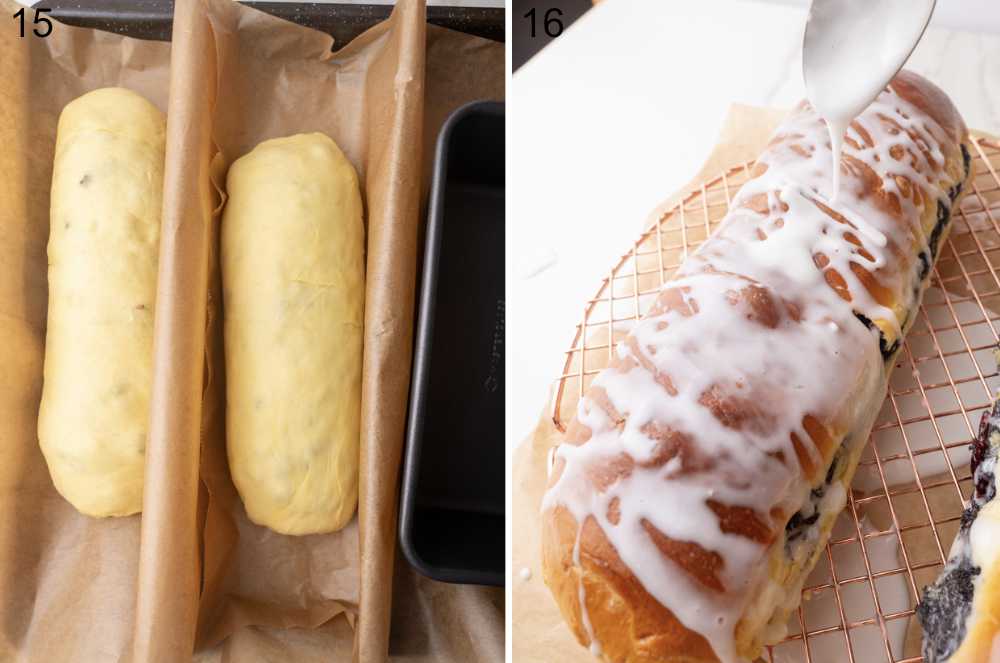
STEP 15: Place the rolls on the baking sheet so that one roll is close to the edge of the baking sheet and the second roll is close to it (with some distance between them), and they are divided with a piece of buttered parchment paper. I place a small baking dish on the other side of the roll. By doing this, the rolls rise taller instead of baking flat (this step is optional).
Cover the rolls with a piece of plastic wrap or a clean kitchen towel.
Second rise: Let rise for about 45 minutes (this takes longer than usual because the dough was a little bit cold). Make a poke test – touch the dough with a lightly floured finger; if the indentation springs back slowly and does not disappear completely, the rolls are ready to bake (if the dough springs back instantly, it needs more time to rise; if the indentation stays and doesn’t spring back at all, the dough is overproofed, bake it immediately). The rolls should puff noticeably.
When the rolls are ready, place the baking sheet in the oven.
Bake and finish
STEP 16: Bake the rolls for about 45 minutes or until the temperature inside the roll has reached about 200°F (92°C). I insert a probe thermometer into the center (not just the top) to be sure (every oven bakes differently and I had problems before with my rolls being underbaked in the middle). If your roll is underbaked, you can always bake it a little longer, even if it has already cooled. The inside of the roll should not be wet, and the dough in the middle should look set, soft, and fluffy, not dense or gummy. The rolls may get too dark towards the end of the baking time; I usually cover them with a piece of aluminum foil after 30 minutes of baking.
Take the baking sheet out of the oven and gently slide the rolls onto a cooling rack. Don’t try to move them too much while they are hot and soft.
Let cool completely and decorate (I would really recommend waiting at least an hour to get a middle that is completely risen and set, then you can cut into it nicely, and the spiral will be nicely noticeable and not ‘smeared’ with the hot filling).
If your roll has cracked at the side, this is just a visual problem that will get covered with a glaze! This type of roll cracks often because there is a lot of filling that is rich and moist while the dough is thin and soft. But this is the only way a good poppy seed roll should taste – soft and delicate dough + lots of filling!
Place a piece of parchment paper under the cooling rack (for an easier clean up).
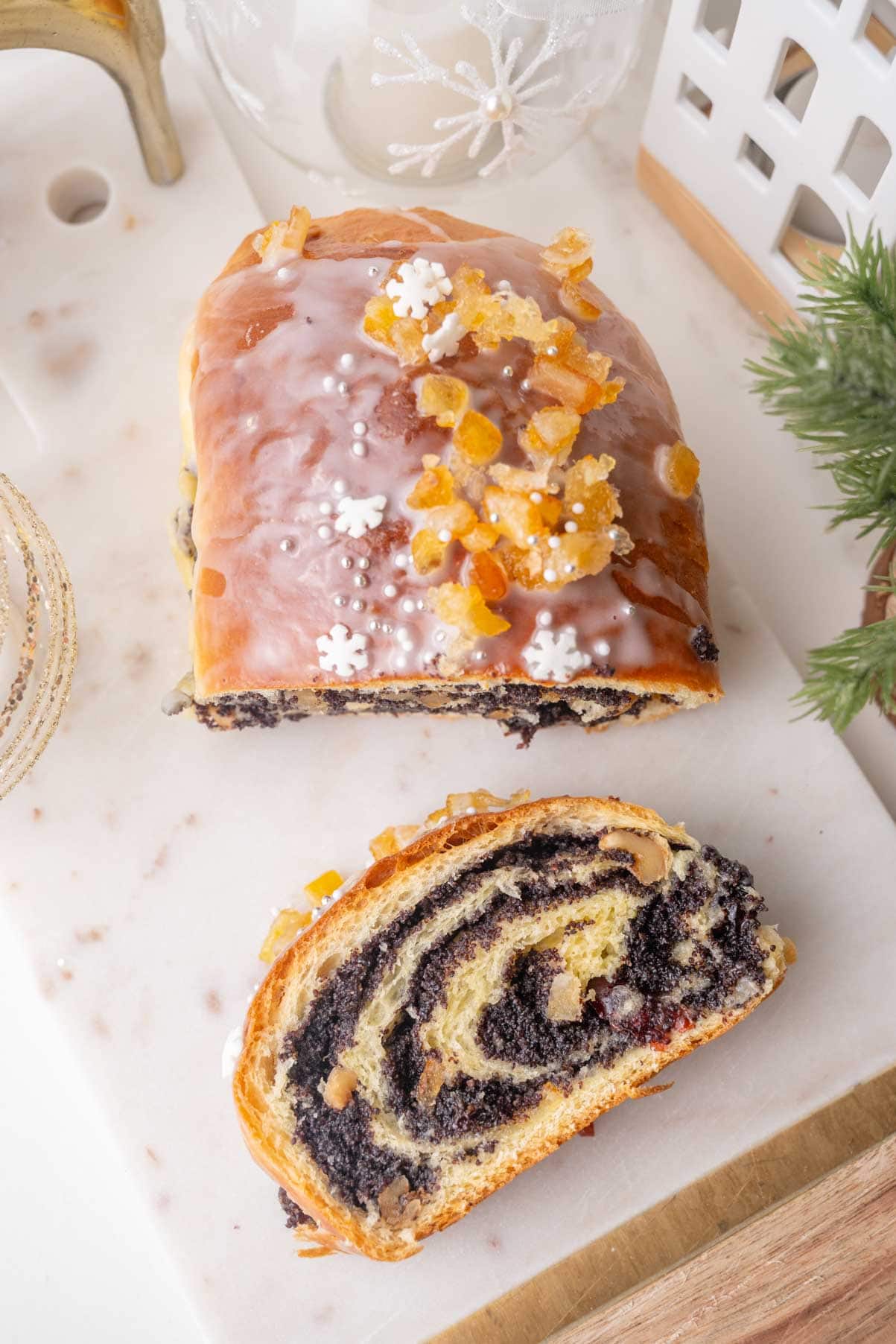
Make the icing: Whisk the ingredients for the glaze and pour it over the roll. Decorate with candied orange peel.
Cut into slices and serve. Enjoy!
Storage
Keep the poppy seed roll covered at room temperature for up to 3 days or in the fridge for up to 5 days (wrapped tightly so it doesn’t dry out). It tastes very good the next way so this is a good dessert to make ahead.
The roll freezes well. Freeze whole or sliced, well wrapped. Thaw at room temperature, then gently reheat in a low oven if you’d like it warm.
Top tips for making poppy seed roll
- Chill the dough – After the first rise, chill the dough briefly. Cold dough is much easier to roll out evenly and handle without tearing.
- Use thick, cool filling – The filling must be thick and not watery or loose, and it should be cooled before you spread it on the dough. If it turns out too runny, thicken it with fine breadcrumbs – add them and let the filling stand for 10–15 minutes so they can absorb the extra liquid.
- Don’t overfill and leave a border – Spread a thin, even layer of filling and leave a ½–¾ inch (1.5–2 cm) border. Too much filling or filling right to the edge makes the roll crack and leak.
- Don’t roll too tightly – Roll the dough snugly but not very tight. If it’s rolled too tight, the dough can stretch too thin and burst in the oven.
- Let it rise long enough – Before baking, do the poke test: if the dough springs back instantly, it needs more time; if the indentation springs back slowly and doesn’t disappear completely, it’s ready to bake (if it stays and doesn’t spring back at all, it’s overproofed).
- Check the inside temperature – For best results, bake until the center of the roll reaches about 200°F (92°C). This helps avoid a raw or gummy middle.
Did you make this recipe? RATE THE RECIPE or tell me in the COMMENTS how you liked it! You can also add a photo of your dish. It would make me very happy and will help other readers. Thank you!!
Poppy Seed Roll

Ingredients
For the dough:
- ½ cup (120ml) milk
- 1 package (7g or 2 ¼ teaspoons) instant yeast
- 2 ½ cups (310g) flour spooned and leveled, +1 Tbsp for working with the dough
- ¼ teaspoon salt
- ¼ cup (50g) sugar
- 2 teaspoons pure vanilla extract
- 1 large egg
- 2 large egg yolks reserve the egg whites for the filling
- 5 tablespoons (70g) soft butter
For the filling:
- 2 ¼ cups (200g) ground poppy seeds if you only have whole poppy seeds – see notes
- 1/3 cup (80g) milk
- 2 tablespoons honey
- 1/3 cup (50g) chopped candied orange peel + more for decoration
- ½ cup chopped nuts I used walnuts and almonds
- ¼ cup raisins roughly chopped
- ¼ cup dried cranberries roughly chopped
- ½ cup +2 tablespoons (125g) brown sugar
- 1 tablespoon pure vanilla extract
- ¼ teaspoon cinnamon
- 1/8 teaspoon almond extract
- 1 tablespoon fine breadcrumbs
- 3 tablespoons soft butter
- 2 large egg whites
For the glaze:
- 1 1/2 cups (180g) powdered sugar
- 1 ½ tablespoons water
- 1 ½ tablespoons lemon juice
Would you like to save this?
Instructions
- In the post you will find a lot of step-by-step photos which you can consult if something is unclear to you.
Make the dough:
- Cut the cold butter into small cubes and place it on a plate. This way the butter should become soft by the time we need to incorporate it into the dough.5 tablespoons (70g) soft butter
- Warm up the milk until it reaches a temperature of 100–110°F (38–43°C) or feels pleasantly warm to the touch. Stir in the yeast.½ cup (120ml) milk, 1 package (7g or 2 ¼ teaspoons) instant yeast
- To a large mixing bowl, add flour, salt, sugar, vanilla, lightly beaten egg, and egg yolks. Pour in the milk–yeast mixture.2 ½ cups (310g) flour, ¼ teaspoon salt, ¼ cup (50g) sugar, 2 teaspoons pure vanilla extract, 1 large egg, 2 large egg yolks
- Knead the ingredients for a couple of minutes until well combined, then gradually add the soft butter, one small piece after the other, and mix until incorporated.
- Knead the dough by hand for 10–15 minutes or with a hand mixer fitted with a dough hook for about 5–10 minutes, until a smooth dough forms. If using a mixer, when the dough is nearly ready, transfer it to the counter and finish kneading by hand.
- Cover the bowl with plastic wrap and let rise in a warm place until doubled in size, about 1 hour. I usually place it in a turned-off oven with the light on.
Make the filling:
- I am using store-bought ground poppy seeds in this recipe for convenience. If you have whole poppy seeds, see notes.
- Add milk and honey to a medium saucepan and bring to a boil. Add ground poppy seeds and stir until combined, cook for a minute, then take off the heat. Make sure the poppy seeds are thick and there is no liquid visible.2 ¼ cups (200g) ground poppy seeds, 1/3 cup (80g) milk, 2 tablespoons honey
- Add the poppy seeds to a large bowl and add all the other ingredients for the filling except the egg whites. Stir until everything is well combined and there are no streaks of butter. Make an indentation in the middle of the filling and spread it up the sides of the bowl so that all of the filling chills uniformly. Place the bowl in the fridge while you are whipping the egg whites.1/3 cup (50g) chopped candied orange peel, ½ cup chopped nuts, ¼ cup raisins, ¼ cup dried cranberries, ½ cup +2 tablespoons (125g) brown sugar, 1 tablespoon pure vanilla extract, ¼ teaspoon cinnamon, 1/8 teaspoon almond extract, 1 tablespoon fine breadcrumbs, 3 tablespoons soft butter
- Whip the egg whites with a pinch of salt until stiff (if you turn the mixing bowl upside down, the egg white foam should not move), but be careful not to overbeat them.2 large egg whites
- Take the filling out of the fridge and carefully fold in the egg whites in three increments. Do not stir vigorously so you don’t lose the puffiness of the whipped egg whites too much.
- Set aside.
Assemble:
- By the time you are done with the filling, the dough should have risen. Punch the dough down to release gases and place it on a piece of parchment paper. Sprinkle 1 Tbsp of flour on all sides of the dough and stretch it into a small rectangle and cut it in half. Cover with another piece of parchment paper and put in the fridge for 10 minutes (this will help to roll out the dough to an even thickness and also firm it up so it is easier to handle while rolling it up into a roulade).
- After 10 minutes, take one piece of dough from the fridge and roll it out into a rectangle, about 8×12 inches (20×30 cm).
- Spread half of the filling in an even layer over the dough, leaving a ½–¾ inch (1.5–2 cm) border.
- Roll up from the short side into a roll. Help yourself with the parchment paper which should be under the dough – lift the paper and the dough should roll onto itself. Don’t try to roll the dough too tightly – it will stretch and may get too thin (the dough is quite delicate, that’s why we chilled it a bit).
- Tuck the edges under the dough and place (or slide the roll) on a baking sheet lined with buttered parchment paper, seam-side down.
- Repeat with the second part of the dough and filling.
- Place the rolls on the baking sheet so that one roll is close to the edge of the baking sheet and the second roll is close to it (with some distance between them), and they are divided with a piece of buttered parchment paper. I place a small baking dish on the other side of the roll. By doing this, the rolls rise taller instead of baking flat (this step is optional).
- Cover the rolls with a piece of plastic wrap or a clean kitchen towel.
Second rise:
- Let rise for about 45 minutes (this takes longer than usual because the dough was a little bit cold). Make a poke test – touch the dough with a lightly floured finger; if the indentation springs back slowly and does not disappear completely, the rolls are ready to bake (if the dough springs back instantly, it needs more time to rise; if the indentation stays and doesn’t spring back at all, the dough is overproofed, bake it immediately). The rolls should puff noticeably.
- When the rolls are ready, place the baking sheet in the oven.
Bake and finish:
- Bake the rolls for about 45 minutes or until the temperature inside the roll has reached about 200°F (92°C). I insert a probe thermometer into the center (not just the top) to be sure (every oven bakes differently and I had problems before with my rolls being underbaked in the middle). If your roll is underbaked, you can always bake it a little longer, even if it has already cooled. The inside of the roll should not be wet and the dough in the middle should look set, soft, and fluffy, not dense or gummy. The rolls may get too dark towards the end of the baking time; I usually cover them with a piece of aluminum foil after 30 minutes of baking.
- Take the baking sheet out of the oven and gently slide the rolls onto a cooling rack. Don’t try to move them too much while they are hot and soft.
- Let cool completely and decorate (I would really recommend waiting at least an hour to get a middle that is completely risen and set, then you can cut into it nicely and the spiral will be nicely noticeable and not ‘smeared’ with the hot filling).
- If your roll has cracked at the side, this is just a visual problem that will get covered with a glaze! This type of roll cracks often because there is a lot of filling that is rich and moist while the dough is thin and soft. But this is the only way a good poppy seed roll should taste – soft and delicate dough + lots of filling!
- Place a piece of parchment paper under the cooling rack (for an easier clean up). Whisk the ingredients for the glaze and pour it over the roll. Decorate with candied orange peel.1 1/2 cups (180g) powdered sugar, 1 ½ tablespoons water, 1 ½ tablespoons lemon juice
- Cut into slices and serve.
- Enjoy!
Notes
- Measuring flour: I use the spoon-and-level method (1 cup = 125g). Fluff the flour, spoon it into your cup, then level it with a knife. A digital scale will give the best and most consistent results.
- If you only have whole poppy seeds: This recipe uses ground poppy seeds for convenience. If you only have whole poppy seeds, grind the same weight in a poppy seed grinder or a coffee/spice grinder, in small batches, until very fine and slightly moist/oily. Then use them exactly as written in the recipe (heat with milk and sugar).
You can also first simmer the whole poppy seeds in enough milk to cover them for about 10 minutes, drain well, then grind them while still warm in a poppy seed grinder. Use them straight away, without cooking them again in milk. Make sure the poppy seed mixture is thick and not watery. - The filling must be thick and not watery or loose! If it turns out too runny, thicken it with fine breadcrumbs (add the breadcrumbs and let it stand for 10–15 minutes to give them time to absorb the extra liquid).
- Calories = 1 serving (1/20 of the recipe). This is only an estimate!
2 Comments
Helen
8 December 2025 at 00:54My family loved this!
Aleksandra
8 December 2025 at 07:17I am so happy to hear this, thank you for leaving the comment!